Adult AI Chat Etiquette: Working With Guidelines
Guidelines are the part of an adult chat platform that decides what a service will and will not do, and they are published rather than hidden, which makes them usable. The FAQ on the platform's own chat pages answers the restriction question directly: some limitations apply in accordance with the platform's content and community guidelines. Etiquette is simply the reader's half of that arrangement, and it starts with reading the boundary instead of guessing at it.

Key takeaways
- A guideline defines the edge of what stays available; it says nothing about how well a conversation is written inside that edge.
- Unfiltered is a catalogue label alongside Filtered and 18+, not a claim that no rule exists anywhere in the service.
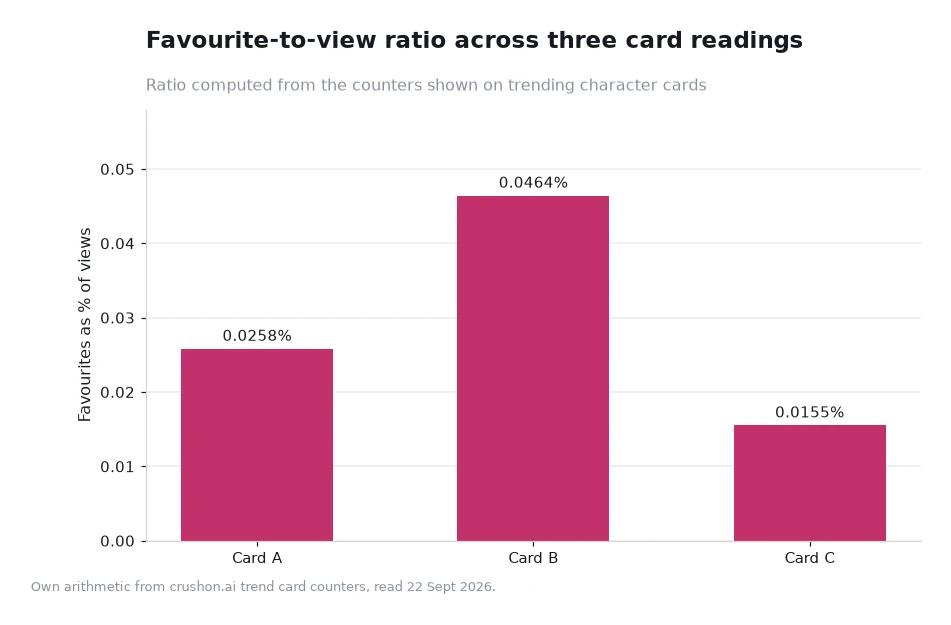
- Favourite-to-view readings between 0.0155% and 0.0464% describe how often visitors save a card, not how well the card respects a boundary.
- Reporting is a supported path: every content page can be reported, and [email protected] is the published contact for both content and compliance questions.
What a guideline decides, and what it does not
A guideline decides availability. It sets the outer edge of what a platform keeps on its pages, and it is written by the operator rather than negotiated per conversation. What it does not do is grade the conversation inside that edge: two entries sitting side by side under the same access label can differ enormously in how much context their creator wrote and how well they hold a thread.
That separation is the reason etiquette earns its own discussion. If a guideline is the fence, etiquette is what you do with the field — how you open a conversation, how much you put in, and how you handle the moment something does not land. Confusing the two leads to two opposite errors: assuming the platform will police every preference for you, or assuming that nothing is out of bounds because the catalogue calls itself unfiltered.
Three places where etiquette meets policy
The first is the catalogue itself. Filters run across Filtered, Unfiltered and 18+, and the profile of the service is stated plainly: it is an NSFW character platform for adults, and its content is described as AI-generated text that depicts no real person. Reading a card as if it were anything other than a written character is a misunderstanding of the service, not a rule you were expected to infer.
The second is expectation setting. Crushon describes Sex AI companions that adapt to your personality and remember your preferences, and the operator also says that responses are natural and adaptive. Those two statements sit comfortably together with a boundary, because adaptation is about continuity of style, not about a promise that every request is available.
The third is the reporting route. Every content page can be reported, and [email protected] serves as both the content and compliance contact. Knowing that path matters for etiquette in a practical way: you are not expected to resolve a disagreement with a card by arguing with it, and a report is a normal, supported action rather than an escalation.
| Question | Stated position | What it means in practice | Common misreading |
|---|---|---|---|
| What is on offer | AI-generated text, no real people depicted | Treat the exchange as written fiction | Expecting photos or video |
| Are there limits | Some limitations apply under the content and community guidelines | The edge exists and is published | Reading unfiltered as unmoderated |
| How private is it | A private and secure environment with state-of-the-art encryption | It describes handling, not an absolute | Turning a wording into a promise |
| What if a card breaks a rule | Report from the content page or contact support | Reporting is a supported route | Assuming nothing can be reported |
| Who may use it | Adults only | Age is part of the terms, not a suggestion | Treating age limits as decoration |
Worked example: two cards, one guideline lens
Take three readings taken from trending cards on the same day. Card A sits at 0.0258% favourites against views, Card B at 0.0464% and Card C at 0.0155%. Divide the strongest by the weakest: 0.0464 ÷ 0.0155 = 2.99, so the best-performing card in that set converts about three times as well as the weakest.
Now apply the guideline lens. If Card C carries a broad label and a single line of description while Card B carries a precise label set and a written setup, part of the gap is explained by how clearly each card signalled what it was. Signal, not permissiveness, is the variable a reader can act on.
A second calculation turns a habit into time. Assume three sessions a week at 25 minutes each: 3 × 25 = 75 minutes a week, or about 300 minutes a month, which is 5 hours. Both the session count and the duration are illustrative assumptions rather than platform data, and the point of the arithmetic is that a small weekly budget is enough to test a handful of cards properly instead of skimming a screenful.
Etiquette in the detail
Put the boundary in the first message rather than the fifth. A short opening that states what you are looking for costs two sentences and saves a session, because it tells the card what to hold onto and gives you an early read on whether the fit is there. Start from the https://crushon.ai/ai-sex-chat page if you want the operator's own framing of adaptation, memory and privacy before you decide how to open.
Two habits complete the picture. Learn where the reporting route lives before you need it, so that a card which genuinely crosses a line is handled through the content removal policy instead of a looping argument. And keep a note of what you changed in a conversation when it improved — style, length, how much setup you gave — because that record is what makes the next session start faster. Process questions belong with the complaints policy, which is the published channel for exactly that kind of query.
Frequently asked questions
Does an unfiltered catalogue mean there are no rules?
No. Unfiltered describes which part of the catalogue you are browsing, and the platform states that some limitations apply in accordance with its content and community guidelines.
Is it bad etiquette to test many cards quickly?
Not if the test is a real conversation rather than a greeting dropped and abandoned. A few messages with three cards tells you more than one message sent to thirty.
What should I do if a card misrepresents itself?
Leave it and move on. If it breaches the platform's rules rather than merely failing to match your taste, the content page has a report route and the support address is published.
Why does the platform mention restrictions at all?
Because a service that publishes its limits is easier to use than one that leaves them to be discovered. Restrictions are part of the terms of use, and reading them takes a minute.
Treat the boundary as a feature
Etiquette on an adult AI platform is mostly about reading the published material and then behaving like a participant rather than an inspector. Learn the filters, know the reporting route, open with two sentences of intent, and let the card's own setup do the rest. Readers who do that spend their session budget on conversations instead of on relearning how the service is meant to work.
Data and sources: platform FAQ wording on restrictions, adaptation and privacy[1], read 22 Sept 2026. Ratios are own arithmetic on trend card counters; the weekly session budget is an illustrated assumption. Adults 18 and older only.